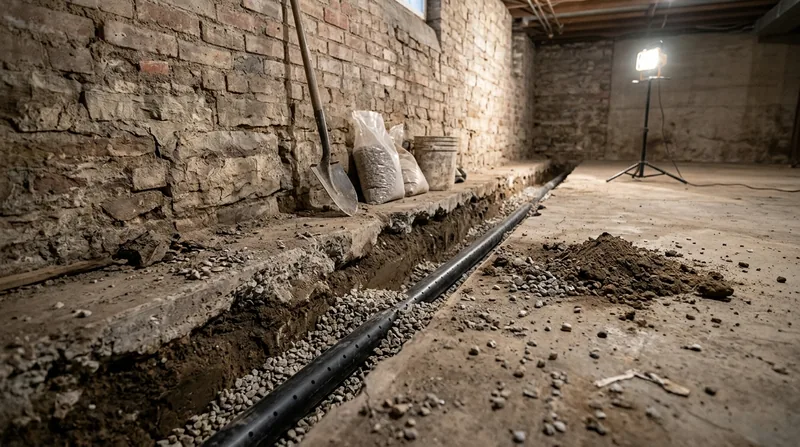




Interior Drain Tile System in Decatur: Stop Water at the Footing
Decatur sits on flat central Illinois prairie where the Sangamon River was dammed to form Lake Decatur, and that geology matters once water starts showing up in a basement. The city is built on deep black silt loam over dense glacial till clay that drains slowly, and on former wet prairie the water table stays high most of the year. An Interior Drain Tile System in Decatur captures that water at the footing before it can push through the slab or the cove joint, then routes it to a sump basin and pumps it out.
We work the whole range of local housing stock: 1870s to 1910s Victorian and Italianate homes in the historic West End on brick and limestone foundations, 1900s to 1920s Prairie and Craftsman homes, bungalows and foursquares near Millikin University, and 1950s to 1970s brick ranches in south and north Decatur. Newer poured-concrete basements in Mount Zion, Forsyth and around Lake Decatur get the same treatment.
If you already know the pattern (water after every heavy spring rain, a musty basement smell, efflorescence on the block), skip straight to free basement inspection and we will tell you straight whether you need drainage or just crack sealing.
Why Decatur Basements Take On Water From Below
The dominant failure mode here is not a single cracked wall. It is hydrostatic pressure from saturated glacial clay pushing against the footing and the slab edge after days of spring rain, snowmelt, or a summer cloudburst. Water that cannot move down through the clay spreads sideways under the slab and finds the weakest point, usually the cove joint where the wall meets the floor.
- Water seeps through the cove joint and along the base of the wall after heavy rain, leaving a wet basement floor and damp lower block.
- Efflorescence (the white salt bloom on brick and block) shows that moisture is moving through the masonry, not just condensing on it.
- Old clay or collapsed footing drains under 1920s homes near the West End stop carrying water and back up instead.
- Downspouts that dump next to the foundation and flat lots with poor grading send roof water straight into the same clay.
- A sump pump that runs constantly or short-cycles points to a water table problem, not a pump problem.
When those signs stack up, an interior perimeter drain is usually the honest answer, and simple crack sealing will not hold against that kind of pressure.
Key info: A 1915 foursquare on a full basement near Millikin University with water across the floor every March is a classic Decatur footing-drain failure. An interior drain tile system under the slab edge handles it without digging up the yard or the tree roots.
For the official position on permits and inspection for work that alters drainage, check the City of Decatur's building and safety pages at decaturil.gov before work starts.
How We Install an Interior Drain Tile System in Decatur
We start by finding out where the water is actually coming from. On a 1950s brick ranch in south Decatur that means checking the cove joint, the block courses, the window wells and the existing sump basin before we quote anything. Then we cut, lay pipe, and backfill in a sequence that keeps the basement usable.
- We break and remove a 12 to 16 inch strip of slab along the perimeter wall and dig down to the footing.
- We lay perforated drain tile in a washed-gravel bed against the footing, with the holes facing down so silt does not clog the pipe.
- We tie the perimeter run into a sump basin set at the low corner of the basement, then connect the sump pump and check valve.
- We run the discharge line to daylight or a dry well, keeping it clear of the foundation and away from the neighbor's lot line.
- We cover the trench with dimple board and a vapor barrier before pouring new concrete back over the strip.
- We test the system with water and walk the homeowner through the pump, the check valve and the discharge route.
Most jobs leave the basement cleaner than we found it, with the new concrete strip flush to the old floor.
Key info: On a 1920s bungalow in the West End with a limestone footing, we hand-dig near the wall so we do not crack the stone. On poured-concrete basements in Forsyth we can cut faster and finish the same day.
If the existing drain tile is collapsed rather than missing, drain tile repair and replacement may be the smaller job. We tell you which one you have.
Interior Drain Tile System Near Me: Matching the Method to the House
Not every wet basement in Decatur needs the same system. A 1990s poured-wall home in Mount Zion with a failed exterior footing drain is a different job from an 1890s Italianate on a rubble limestone foundation in the historic district. The table below shows the approaches we actually use and where each one fits.
| Approach | Description | Best for |
|---|---|---|
| Interior perimeter drain tile | Perforated pipe in gravel along the footing inside the basement, feeding a sump basin. | Full basements with water at the cove joint and a high water table. |
| Interior drain with dimple board and vapor barrier | Drain tile plus a wall membrane that channels seepage down to the pipe. | Damp block walls and efflorescence on 1950s to 1970s ranches. |
| Sump basin and pump upgrade | New basin, primary pump and check valve tied into the new drain run. | Existing pump that cannot keep up during spring storms. |
| Crack injection before or after drainage | Epoxy or polyurethane injection into a poured-wall crack to close the path. | A single active crack that is not a whole-perimeter water problem. |
| Exterior footing drain excavation | Digging outside to the footing, new drain and waterproof membrane. | Cases where the wall itself is failing and needs the outside opened. |
We compare interior and exterior options on the same visit so you are not guessing.
Interior Drain Tile System Cost in Decatur: What to Expect
Pricing for an interior drain tile system in Decatur starts at From $50 per linear foot for a standard perimeter run with a new sump basin and pump connection. That figure moves with the length of wall you actually need to drain, the depth of the footing, and whether the concrete is original 1920s slab or a newer pour.
- Perimeter length drives the number more than anything else, so a small bungalow basement costs less than a full ranch footprint.
- Footing depth and foundation type matter: rubble limestone and brick footings in the West End take more hand work than poured concrete in Forsyth.
- Access to the basement (narrow stairs, finished ceilings, tight turns) adds labor on 1900s homes.
- Adding a new sump basin, check valve and discharge line is a separate line item from the drain tile itself.
- Battery backup and a second pump are options we quote separately, not bundled surprises.
Get two or three written estimates and make sure each one lists the pipe, gravel, sump basin, pump and concrete restoration separately. For the full breakdown, see our pricing overview.
Hiring a Waterproofing Contractor Near Decatur: What to Check
Interior drain tile is a below-slab job, and once the concrete is back you cannot see the pipe. That makes the contractor choice more important than the brand of pipe. Ask direct questions and expect direct answers, especially about who pulls the permit and who handles the concrete restoration.
- Confirm the company is licensed and insured, and ask for a certificate of insurance naming you as certificate holder.
- Get at least three estimates on site, not over the phone, because footing depth and access change the price.
- Ask for references from Decatur, Mount Zion or Forsyth homeowners with the same foundation type.
- Ask who pulls the permit if the work alters drainage or the sump discharge connection, since rules vary by jurisdiction and the local building department has the final word.
- Ask what warranty you get and whether it is transferable to a future owner.
We are a Basement Health Association member and we put the scope in writing before we cut concrete. Reach us through the contact page or call (217) 859-8629.
Interior Drain Tile System in Decatur: Pricing Guide
| Service | Price | Details |
|---|---|---|
| Standard interior perimeter drain tile | Starting at $50/linear ft | Includes pipe, washed gravel, trench cut and concrete restoration along the wall. |
| Drain tile with sump basin and pump | Starting at $1,800 additional | Adds new basin, primary sump pump, check valve and discharge line to daylight. |
| Drain tile plus dimple board and vapor barrier | Starting at $62/linear ft | Adds wall membrane and vapor barrier for damp block walls and efflorescence. |
| Complex or large-scale job | On estimate | Rubble limestone footings, finished basements and deep footings need an on-site look first. |
| Travel | Included | In Decatur and surrounding Macon County towns, with no separate call-out or mileage fee. |
| Estimate | Free | Response within 24 hours at (217) 859-8629, with no obligation to book. |
Indicative pricing, the exact cost depends on square footage, finish, and site access. Free personalized estimate within 24h at (217) 859-8629.


