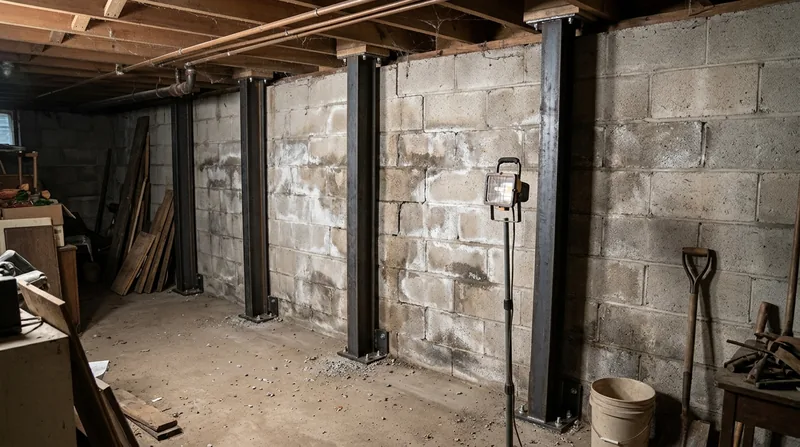




Bowing Wall Repair in Decatur: Stabilize the Wall Before the Clay Pushes It Further
If you have watched a basement wall lean inward over a season or two, you are looking at Bowing Wall Repair in Decatur, and the cause is almost always the same: saturated glacial clay and winter frost pushing against a block or poured wall that was never built to take that load. Decatur sits on flat central Illinois prairie where deep black silt loam rests on dense glacial till clay that drains slowly, and the high water table on the old wet prairie keeps that clay heavy through spring. The 1950s to 1970s brick ranches and split-levels on block basements in south and north Decatur show the classic inward bow, while the 1910s to 1940s bungalows near Millikin University often show a horizontal crack at mid-wall first. We match the repair to the severity of the movement and the soil under your footing, not to a one-size kit. Start with a free basement inspection so we can measure the deflection before anything is strapped.
Why Bowing Walls Are Common in Decatur's Clay and Frost Cycles
A bowing wall is a pressure problem, not a cosmetic one. When the clay outside stays wet, it expands, and when a hard freeze follows, the frost lens adds more lateral load. The wall cracks at mid-span, the top or bottom course kicks, and the block joints open. On the flat prairie around Lake Decatur, that cycle repeats every winter and spring.
- Hydrostatic pressure builds when clay soil cannot drain and water stacks up against the wall.
- A failed footing drain or clogged weeping tile lets the water table sit against the foundation instead of carrying it away.
- Downspouts that dump at the corner and grading that slopes back to the house feed the same clay.
- Freeze-thaw cycles in January and February push frost into the backfill and add load the wall was never designed for.
- Block walls in post-war Decatur homes crack at the mortar joints before a poured wall shows visible movement.
Reading the wall early is what keeps a strap job from turning into a rebuild, so measure the gap at the top and bottom of the wall and write down the date.
Key info: A split-level in south Decatur with a block wall bowed about 1 inch at mid-height is a strap candidate. The same wall bowed 2.5 inches with a sheared top course needs steel I-beams and an engineered plan, and we say so up front.
For the state's consumer guidance on hiring and verifying a contractor, the Illinois Department of Financial and Professional Regulation is the official starting point.
How We Diagnose and Repair a Bowing Wall in Decatur
We do not strap a wall until we know why it moved. The inspection measures deflection, checks the footing drain, looks at grading and downspout discharge, and reads the block joints for shear. Then we pick the method that matches the movement and the soil.
- We map the wall with a string line and a level and record the maximum deflection in inches.
- We inspect the footing drain and the interior perimeter for water, because a dry wall stays put and a wet one keeps moving.
- We check grading, downspout extensions, and window well drainage on the wet side of the house.
- We recommend carbon fiber straps for moderate bowing, steel I-beams for heavy loads, or wall anchors where the soil outside allows.
- We address the water source with an interior drain tile system so the repair is not fighting a wet wall.
- We pull the permit where the local building department requires one for structural foundation repair.
The goal is a wall that stops moving and a water path that keeps the clay from reloading it.
Key info: On a 1962 brick ranch off West Main in Decatur, the wall had bowed 1.25 inches and the footing drain was packed with clay. We strapped the wall and cleared the drain path, and the movement stopped because the load came off the wall.
Matching the Method to the Movement
No single repair fits every wall. The table below shows how we match the approach to the severity and the soil, and we explain the trade-offs before you commit.
| Approach | Description | Best for |
|---|---|---|
| Carbon fiber straps | Straps bonded floor to joist on the inside face to stop further inward movement. | Moderate bowing under 2 inches on block or poured walls. |
| Steel I-beams | Vertical beams set against the wall and tied into the footing and floor system. | Heavy deflection, sheared block, or walls carrying high soil load. |
| Wall anchors | Earth anchors outside pull the wall back through rods to an inside plate. | Walls with room outside and soil that can hold an anchor. |
| Epoxy or polyurethane injection | Ports inject resin into cracks to seal them and restore some section. | Non-moving shrinkage or settlement cracks, not active bowing. |
| Drainage correction | Interior perimeter drain, sump basin, and discharge line to move water away. | Wet clay against the wall that keeps reloading it. |
We often combine a structural repair with drainage correction, because a dry wall is a stable wall.
Bowing Wall Repair Cost in Decatur: What to Expect
Most homeowners want a number before they commit, and that is fair. A single crack injection can start around $600, while a full strap or beam job runs higher because it involves engineering, materials, and labor. The spread is wide, and the only honest way to price it is after we measure the wall.
- The length of the wall and the number of straps or beams drives the material cost.
- The deflection in inches decides whether straps, beams, or anchors are needed.
- Access to the basement and whether the wall is finished affects labor time.
- Whether drainage correction is added changes the scope and the total.
- Permit fees from the local building department vary by jurisdiction and are part of the job.
Get two or three written estimates and compare the method, not just the bottom line. Our full pricing overview explains how we build a quote.
What to Look For in a Bowing Wall Repair Contractor Near Me in Decatur
Hiring for structural work is different from hiring for a cosmetic repair. Ask for proof of licensing and insurance, get multiple estimates in writing, and ask for references from jobs like yours. A contractor who cannot explain why your wall moved is guessing.
- Confirm the company is licensed and insured and ask for a certificate before work starts.
- Get two or three written estimates that describe the method and the materials.
- Ask for references on similar block or poured walls in Decatur and Mount Zion.
- Ask who pulls the permit and confirm the local building department's requirements.
- Ask how the contractor will address the water source, not just the wall.
If a bid promises a lifetime warranty or skips the drainage question, keep looking. Reach us through the contact page to schedule a free inspection and get a straight answer on what your wall needs.
Bowing Wall Repair in Decatur: Pricing Guide
| Service | Price | Details |
|---|---|---|
| Crack injection (epoxy or polyurethane) | Starting at $600 | Seals a non-moving crack; price rises with crack length and number of ports. |
| Carbon fiber strap installation | Starting at $1,200 | Straps bonded floor to joist; price moves with wall length and strap count. |
| Steel I-beam reinforcement | Starting at $2,800 | Engineered beams tied to footing; price depends on deflection and beam spacing. |
| Wall anchor system | On estimate | Requires outside access and soil that holds an anchor; needs an on-site look. |
| Drainage correction add-on | On estimate | Interior perimeter drain and sump work priced after the water source is confirmed. |
| Estimate | Free | Response within 24h at (217) 859-8629, no obligation to book. |
Indicative pricing, the exact cost depends on square footage, finish, and site access. Free personalized estimate within 24h at (217) 859-8629.


