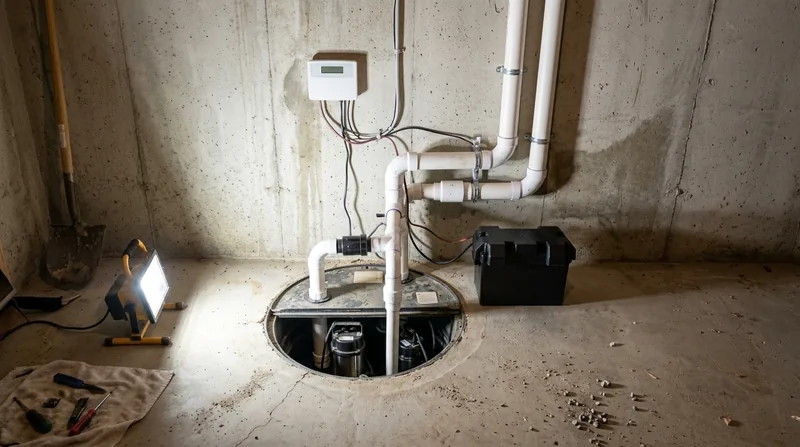




Battery Backup Sump Pumps in Decatur: Keep the Pit Pumping When the Grid Drops
Decatur sits on flat central Illinois prairie where the Sangamon River was dammed to form Lake Decatur, and the ground under most of this city is deep black silt loam over dense glacial till clay that drains slowly. That means your sump pump runs hard during spring rain and summer cloudbursts, and it runs exactly when the power is most likely to fail. A Battery Backup Sump Pumps in Decatur setup keeps water moving out of the pit when a thunderstorm knocks out the grid or an ice storm takes down a line. We size the battery to your pit, your pump, and your actual water volume, not a one-size box off a shelf. If your primary pump is aging, pair this with sump pump installation and replacement so the whole system is matched. Call (217) 859-8629 and we will look at the pit before we quote anything.
Why Battery Backup Matters More in Decatur Than Most Homeowners Realize
The dominant failure mode in this city is not a dead pump, it is a live pump with no power. Decatur gets heavy spring rain, summer cloudbursts, snow, and hard freeze-thaw cycles, and the high water table on former wet prairie keeps the pit full for days after a storm. When the power drops mid-storm, a primary pump stops with the basin at its highest. Homes near Millikin University and on the east side sit on full basements with original drain tile that moves a lot of water fast.
- Spring thunderstorm outages hit when the water table is already high and the pit is refilling every few minutes.
- Winter ice storms take down lines for hours, and snowmelt in February and March keeps the pump cycling around the clock.
- Older 1910s to 1940s bungalows and foursquares often have undersized pits that fill faster than a small backup can keep up with.
- Homes in Mount Zion, Forsyth, and around Lake Decatur with poured-concrete basements still need backup coverage because the soil above them drains slowly.
A backup is not a luxury item here. It is the difference between a dry slab and a wet basement after the storm passes.
Key info: In the historic West End, Italianate and Queen Anne homes on brick and limestone foundations often have a sump pit added decades after the house was built. We check pit depth, inflow rate, and discharge routing before recommending a battery size, because a backup that runs dry in 40 minutes does not solve a Decatur spring storm.
For the local code side of sump discharge and drainage alterations, check the City of Decatur building department before work starts: https://www.decaturil.gov/.
How We Install a Battery Backup System in a Decatur Basement
We start by measuring what your pit actually does during a wet cycle, not by guessing from square footage. Then we match the backup pump, battery, and charger to that inflow, and we test the float and alarm before we leave. The job is usually done in a single visit, and we walk you through the maintenance schedule so the battery is ready when you need it.
- We inspect the existing pit, primary pump, check valve, and discharge line for capacity and backflow issues.
- We measure inflow and pit recovery time to size the backup pump and battery runtime correctly.
- We install the backup pump on its own float switch so it activates independently of the primary.
- We mount the battery and charger in a dry, accessible spot and wire the alarm to sound on power loss or high water.
- We test the full cycle under load and confirm the discharge line routes water away from the foundation.
If the pit itself is too shallow or the discharge line is undersized, we tell you that plainly before we sell you a battery that cannot keep up.
Key info: A 1950s brick ranch in south Decatur with a block basement and a shallow pit often needs the basin deepened before a backup makes sense. A 1990s home in Forsyth with a poured wall and a proper basin usually takes a straightforward battery install. Same city, different answer, which is why we look first.
If your pit is fine but the water keeps coming, the real fix may be an interior drain tile system that captures water before it reaches the slab.
Battery Backup Approaches We Use in Decatur Homes
Not every basement needs the same hardware. The right choice depends on your pit, your water volume, and how long outages tend to last in your part of Macon County. Here is how the main options compare in the field.
| Approach | Description | Best for |
|---|---|---|
| Standard battery backup pump | A separate 12V pump on its own float with a deep-cycle battery and charger. | Most Decatur homes with a normal pit and moderate inflow. |
| High-capacity dual battery | Two batteries and a larger backup pump for longer runtime and higher flow. | Homes near Lake Decatur and river bottoms where outages run long. |
| Combination primary and backup unit | One integrated unit with a main AC pump and a DC backup in a single housing. | Tight pits under 1910s to 1940s bungalows where space is limited. |
| Alarm and monitoring add-on | High-water float alarm and power-loss alert added to an existing backup. | Homeowners who want warning before the pit tops out. |
We recommend the smallest system that reliably covers your inflow, because an oversized battery bank is money sitting on a shelf.
Battery Backup Sump Pumps Cost in Decatur: What to Expect
Most battery backup installations in Decatur start around $900, and that figure covers a standard backup pump, a deep-cycle battery, a charger, and the alarm. The number moves up with dual-battery setups, combination units, a pit that needs deepening, or a discharge line that has to be rerouted. Homes in Mount Zion, Forsyth, and around Lake Decatur with high inflow often land in the mid range because runtime matters more there.
Get two or three estimates and ask each contractor the same question: what inflow rate did you size this to, and how many hours of runtime does that battery give me? A quote without that answer is a guess. Our full pricing overview lays out the line items so you can compare apples to apples.
Hiring a Waterproofing Contractor Near Decatur: What to Check
Battery backup work looks simple until a float sticks or a charger fails, so the contractor matters as much as the hardware. Ask for proof of licensing and insurance, and confirm the crew is covered before anyone touches your pit. Get at least two written estimates and compare what is actually included, not just the bottom line.
Ask for local references, especially from homeowners with a similar foundation and pit depth. Confirm who pulls any permit if the work alters drainage or the sump discharge connection, since rules vary by jurisdiction and the City of Decatur building department has the final word. If your home sits in a subdivision with HOA rules, check those before the install date so nothing gets delayed.
We are a Basement Health Association member and we carry insurance on every job. Reach out through our contact and free estimate page and we will schedule a look at your pit.
Battery Backup Sump Pumps in Decatur: Pricing Guide
| Service | Price | Details |
|---|---|---|
| Standard battery backup install | Starting at $900 | Includes backup pump, deep-cycle battery, charger, alarm, and full load test. |
| Dual battery high-capacity system | Starting at $1,450 | Two batteries and a larger pump for longer runtime and higher inflow volume. |
| Combination primary and backup unit | Starting at $1,250 | Integrated AC and DC unit for tight pits where two pumps will not fit. |
| Pit deepening or discharge reroute | On estimate | Needs an on-site look because basin condition and routing vary house to house. |
| Travel | Included | In Decatur and surrounding Macon County areas, no separate call-out or mileage fee. |
| Estimate | Free | Response within 24 hours at (217) 859-8629, no obligation to book. |
Indicative pricing, the exact cost depends on square footage, finish, and site access. Free personalized estimate within 24h at (217) 859-8629.


