



Basement Wall Sealing in Decatur: Stop Damp Walls Before They Get Worse
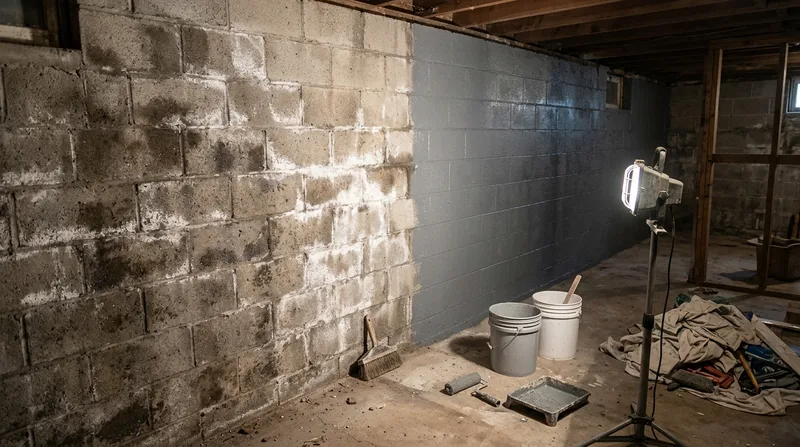
Decatur sits on flat central Illinois prairie where the Sangamon River was dammed to form Lake Decatur, and the ground under most of this city is deep black silt loam over dense glacial till clay that drains slowly. That means water from heavy spring rain, summer cloudbursts, and snowmelt has nowhere to go fast, and it pushes against basement walls instead. If you own a West End Victorian on a brick and limestone foundation, a 1910s bungalow near Millikin University, or a 1960s brick ranch in south Decatur, you already know the pattern: damp walls, white powder on the block, and that musty smell after a wet week. Basement Wall Sealing in Decatur is the first honest step for many of these homes, but only when the problem is surface dampness and not hydrostatic pressure. We tell you which one you have before we sell you anything. Start with a free basement inspection and we will walk the walls with you.
Why Damp Basement Walls Are a Decatur Problem, Not a Cosmetic One
Macon County's clay soil holds water like a sponge and releases it slowly, so basement walls stay wet long after the rain stops. The high water table on former wet prairie ground, plus river bottoms below the dam that flood in heavy rain, keeps hydrostatic pressure on foundations across Decatur, Mount Zion, and Forsyth. On older brick and limestone foundations in the historic West End, that moisture shows up as efflorescence, spalling mortar, and peeling paint. On poured-concrete basements in the 1990s and 2000s subdivisions, it shows up as seepage at the cove joint and damp patches that never quite dry.
- Efflorescence (the white salt powder) means water is moving through the wall and evaporating on the inside face.
- Damp walls raise indoor humidity, which feeds mold growth on framing, stored boxes, and drywall.
- Freeze-thaw cycles in January and February spall brick faces and open mortar joints on older Decatur foundations.
- Sealers slow vapor transmission but they do not stop water being pushed in by hydrostatic pressure.
Sealing buys time and stops surface dampness, but if water is actually pooling, the fix is drainage, not paint.
Key info: A 1920s foursquare near Millikin with white powder on the block and a dry floor after rain is a good sealing candidate. A 1950s ranch in south Decatur with water running across the floor after a storm is a drain tile and sump problem, and sealing alone will fail within a season.
For the official word on what work needs a permit in this city, check the City of Decatur building department before any structural or drainage alteration.
How We Seal Basement Walls in Decatur, Step by Step
We do not sell a sealer as a cure-all. The first job is diagnosis: we check the wall surface, the cove joint, the floor, and the grading outside to see whether moisture is coming through the wall as vapor or being pushed in as liquid water. If the wall is merely damp, we prep and seal. If pressure is the issue, we say so and point you to the right system, often an interior drain tile system that manages water at the footing instead of fighting it at the wall face.
- We inspect the full wall, note efflorescence, cracks, and any bowing, and check exterior grading and downspout discharge.
- We remove efflorescence and loose mortar with wire brushes and a masonry cleaner, then let the wall dry to a sound surface.
- We fill hairline cracks and open mortar joints with a hydraulic cement or masonry patch before any coating goes on.
- We apply a penetrating sealer on brick and block, or a flexible membrane sealer on poured concrete, depending on what the wall is made of.
- We extend downspouts and correct grading so roof and surface water moves away from the foundation instead of soaking the clay beside it.
Every sealing job ends with a walkthrough so you know what was applied, what it will and will not stop, and when to call us back.
Key info: On a 1910s bungalow on Decatur's east side, we found the downspouts dumping directly against the limestone foundation. Sealing the wall without fixing that would have been wasted money. We extended the discharge lines and sealed the wall, and the dampness stopped.
Sealing Approaches We Use and When Each One Fits
Not every wall takes the same product. Brick and limestone foundations in the historic West End behave differently from poured concrete in Mount Zion and Forsyth, and a sealer that works on one can trap moisture and spall the other. Here is how we match the approach to the wall.
| Approach | Description | Best for |
|---|---|---|
| Penetrating sealer | Soaks into brick, block, or concrete and blocks vapor without a surface film. | Damp walls with efflorescence and no standing water. |
| Flexible membrane sealer | Bridges hairline cracks and forms a rubbery barrier on the wall face. | Poured-concrete walls with fine shrinkage cracks. |
| Crack injection first | Epoxy or polyurethane injection fills the crack from the inside out before sealing. | Walls with active seepage at a single crack line. |
| Drainage instead of sealing | Interior perimeter drain and sump relieve pressure; sealing is not the answer. | Wet floors and water after every heavy rain. |
If you are unsure which row describes your basement, that is exactly what the inspection is for.
Basement Wall Sealing Cost in Decatur: What to Expect
Most residential basement wall sealing jobs in Decatur start around $1,500 for a typical single-wall or small basement scope, and the number moves from there. Wall length, wall material, how much efflorescence and mortar repair is needed, and whether cracks must be injected first all change the total. Access matters too: a West End Victorian with a finished basement and limited working room takes more labor than an open poured-concrete basement in Forsyth.
We always recommend getting two or three written estimates and comparing scope, not just price. A low bid that skips surface prep or crack injection is not the same job as one that includes it. Our full pricing overview lays out how we build a quote so you can compare apples to apples.
Hiring a Basement Wall Sealing Contractor Near Me in Decatur
Basement wall sealing looks simple until a sealer traps moisture and spalls a limestone foundation. Ask for proof of licensing and insurance, ask for local references on homes built like yours, and ask whether the contractor will tell you when sealing is the wrong answer. A specialist who only sells coatings will always find a reason to coat the wall.
- Confirm the company is licensed and insured and can send a certificate before work starts.
- Get two or three written estimates with the same scope so you can compare fairly.
- Ask for references from Decatur, Mount Zion, or Forsyth homes with similar foundation types.
- Ask the local building department whether your specific work needs a permit, since rules vary by jurisdiction.
If you want a straight answer about your walls, contact us and we will schedule a free inspection at (217) 859-8629.
Basement Wall Sealing in Decatur: Pricing Guide
| Service | Price | Details |
|---|---|---|
| Single wall, penetrating sealer | Starting at $1,500 | Includes efflorescence removal, masonry prep, and one coat of penetrating sealer on block or brick. |
| Full basement, membrane sealer | Starting at $2,400 | Covers poured-concrete walls with crack prep and flexible membrane; wall length drives the price. |
| Crack injection before sealing | Starting at $650 | Epoxy or polyurethane injection of active cracks, added when seepage is concentrated at a crack line. |
| Complex or large-scale job | On estimate | Finished basements, heavy mortar repair, or multiple wall types need an on-site look before pricing. |
| Travel | Included | In Decatur and surrounding Macon County towns, no separate call-out or mileage fee. |
| Estimate | Free | Response within 24 hours at (217) 859-8629, no obligation to book the work. |
Indicative pricing, the exact cost depends on square footage, finish, and site access. Free personalized estimate within 24h at (217) 859-8629.


